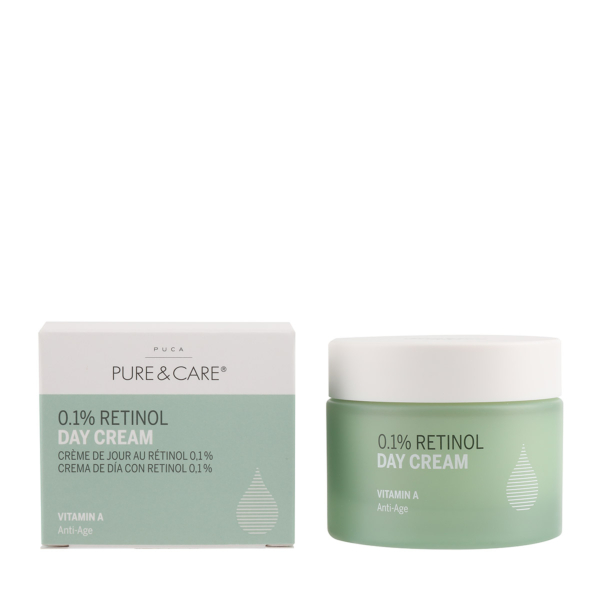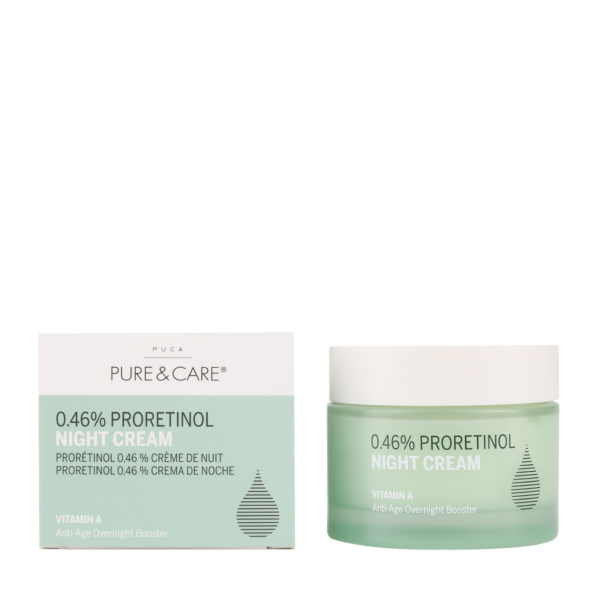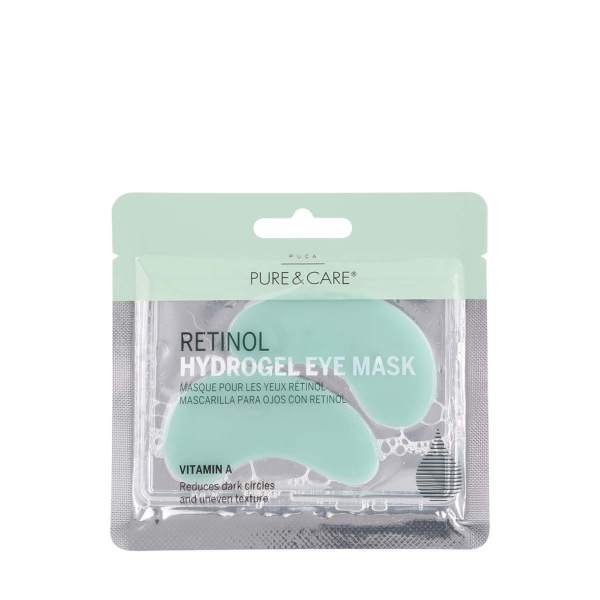
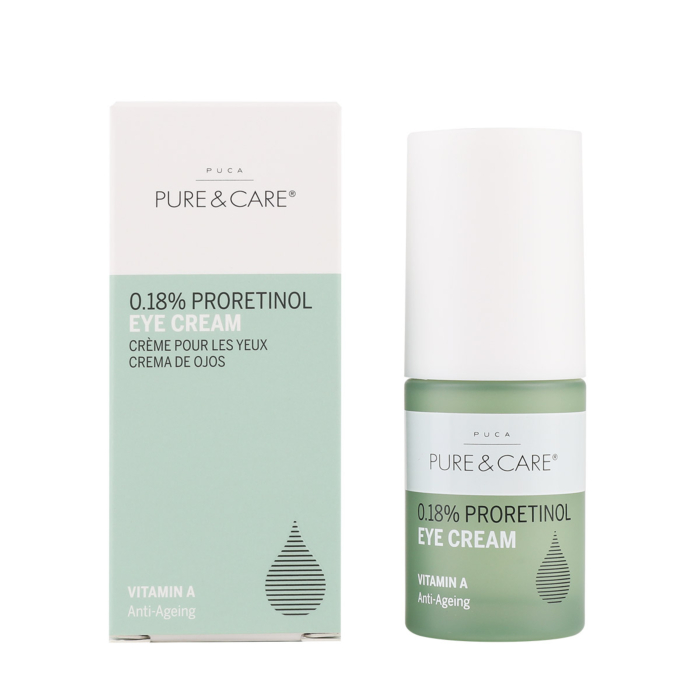
0,18% ProRetinol Eye Cream
PUCA - PURE & CARE Vitamin A Proretinol Eye Cream helps improve the appearance of the skin around the eyes, with active ingredients to promote firmness and elasticity. Its anti-ageing, anti-wrinkle formula helps to reduce dark circles and even out skin texture and tone.
15 mL / 0.51 Fl Oz
0.18% Proretinol eye cream helps reduce signs of ageing and dark circles. Contains vitamin A. Consider your daily intake before use.
Eye cream with 0.18% Retinyl Palmitate which is equivalent to 0.1 % Retinol. Proetinol Eye Cream helps, reduces dark circles and uneven skin texture.
Enhances skin thickness and reduces transparency over time. Use every other day for the first few weeks to accustom the eye to Vitamin A (proretinol) and to avoid redness. Dab the cream around the eye area, but avoid getting too close to the tear ducts. Once the skin has become accustomed to the cream, it can be applied daily, both morning and evening. We recommend using an SPF (Sun Protection Factor) cream with a factor of 15 or higher. After applying your proretinol cream, wait 2–3 minutes before following with SPF cream.
Active ingredients: Panthenol, Vitamin B5-derivative. Moisturising and promotes a healthy complexion. Arginine, an amino acid found in the cells of both plants and animals that boosts moisture retention and skin elasticity. Restorative plant extracts that help to reduce dark circles around the eyes. Oligopeptides 1, 2, and 5 have potential anti-ageing, anti-wrinkle and skin-rejuvenating effects
Suitable for both women and men.
Shelf life: 6 months after opening. Storage: Store in a cool and dark place. Avoid direct contact with the eyes. Contains vitamin A. Consider your daily intake before use.
Are you pregnant and in doubt as to whether Retinol is for you? - read more here
Read more about Retinol, its properties and the use of Retinol here
For this product, the pH value is 6.35 indicated from the 1st batch, read more about pH here
Aqua / Water, Propanediol, Cetyl Ethylhexanoate, Glycerin, Caprylic/Capric Triglyceride, Dicaprylyl Carbonate, Butylene Glycol, Cetearyl Glucoside, Sorbitan Olivate, Glyceryl Stearate, Glyceryl Glucoside, Butyrospermum Parkii (Shea) Butter , Tocopheryl Acetate, Inositol, Cetearyl Alcohol, ***Retinyl Palmitate, Hyaluronic Acid, Sodium Hyaluronate, Collagen, Oligopeptide-1, Oligopeptide-2, Oligopeptide-5, Tocopherol, Panthenol, Avena Sativa (Oat) Kernel Extract, Camellia Sinensis (Tea) Leaf Extract, Chamomilla Recutita (Matricaria) Flower Extract, Centella Asiatica (Asiatic Pennywort) Extract, Pectin, Proline, Serine, Glycyrrhiza Glabra (Licorice) Root Extract, Rosmarinus Officinalis (Rosemary) Leaf Extract, Scutellaria Baicalensis (Chinese Skullcap) Root Extract, Polygonum Cuspidatum Root Extract, Hydrolyzed Wheat Protein, Hydrolyzed Soy Protein, Allantoin, Chondrus Crispus (Carrageenan) Extract, Saccharide Isomerate, Arginine, Citric Acid, Sodium Citrate, Glucose, Potassium Cetyl Phosphate, Xanthan Gum, Caprylyl Glycol, Hexylene Glycol, Ethylhexylglycerin, Carbomer, Sodium Hydroxide, Phenoxyethanol, 4-Hydroxyacetophenone
***We use a "ProRetinol" which appears on the ingredient list as Retinyl Palmitate. Each molecule of Retinyl Palmitate can, by cleavage of the ester bond and consumption of a water molecule (H2O), form Retinol and Palmitic Acid. To calculate how much a certain amount of Retinyl Palmitate corresponds to in the form of Retinol, it is necessary to use the molecular weights. Retinyl Palmitate has the empirical formula C36H60O2 and thus a molecular weight of 524.86 g/mol (Da). Retinol has the empirical formula C20H30O and thus a molecular weight of 288.46 g/mol (Da). The conversion formula is as follows: Amount of Retinyl Palmitate x (Molecular weight of Retinol / Molecular weight of Retinyl Palmitate). If, for example, 0.46% Retinyl Palmitate is used, the calculation is as follows: 0.18% x (288.46 g/mol / 524.86 g/mol) ≈ 0.1% Thus, 0.18% Retinyl Palmitate corresponds to 0.1% Retinol (assuming that all Retinyl Palmitate is cleaved into Retinol and Palmitic Acid).
The product contain Vegetable oils.
The product is without Alcohol and Silicone.
Natural ingredients may vary in color and consistency
Our formulations are updated from time to time therefore the ingredient list shown here may vary from the box of previus production.
Assessment of the study results
None of the 30 subjects showed skin alterations in the test area after
24 h, 48 h and 72 h following application of the epicutaneous test according to the
recommendations of Colipa, the DDG, the DGAKI and ISO 10993-23:2021 (section 8 and Annex E). The product was tolerated very well.
Hence, it can be concluded that, from a dermatological point of view, the tested product does not exhibit a high irritative potential and that the product, if used as intended, will not lead to undesirable skin reactions.
Use every other day for the first few weeks to accustom the eye to Vitamin A (retinol) and to avoid redness.
The eye cream is dabbed around the eye area, but not normally used on the eyelids, where the skin is very delicate.
Avoid getting too close to the tear ducts. When the skin has become accustomed to the eye cream, apply it every day, both morning and evening.
We recommend using a +15 SPF (Sun Protection Factor) cream, let your Retinol work for 2-3 minutes before applying SPF cream.
Retinol can cause skin irritation.
A tip to minimize redness is to apply Hyaluronic Acid Serum before and after applying retinol. These extra layers can mitigate the side effects.